
Written & Researched by: Iqra Fatima Khan
Designation: Health Content Writer & Researcher
Originally Published: September 12, 2026
Last Updated: September 12, 2026
Iqra Fatima Khan creates health and wellness content for BMIICalculator.com, with a focus on BMI education, healthy weight management, nutrition, and general wellness. Content is researched using reputable public-health, medical, and scientific sources. You can also read more about our Editorial Policy and how we research health information.
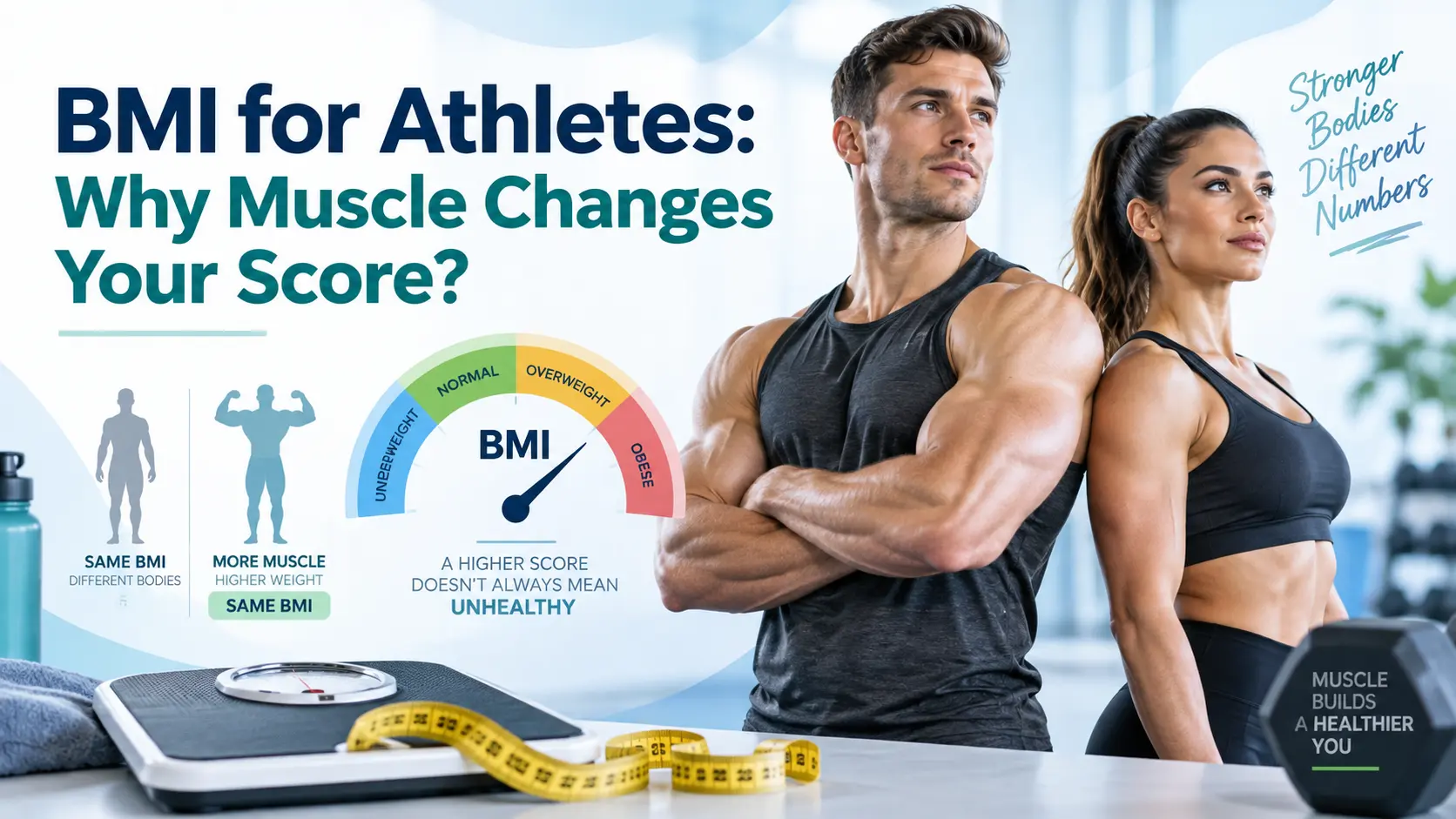
If you train regularly, lift weights, play competitive sports, or have more muscle than the average person, your BMI score may not tell the whole story.
An athlete can be lean, active, and physically fit but still receive a BMI result in the “overweight” range. In some highly muscular people, BMI may even reach the obesity range despite relatively low body fat.
Why does this happen?
The answer is straightforward: BMI uses only your height and weight. It cannot tell whether your body weight comes from muscle, fat, bone, or other tissues.
That does not make BMI useless. BMI remains a convenient screening measurement, but athletes and other muscular adults often need additional information to understand what their BMI actually means.
If you have not checked your BMI yet, use our free BMI Calculator for Adults to calculate your score, healthy-weight range, and optional waist-to-height ratio.
What Is BMI?
BMI stands for Body Mass Index. It compares your body weight with your height using a mathematical formula.
For metric measurements:
BMI = weight (kg) ÷ height² (m²)
For pounds and inches:
BMI = weight (lb) ÷ height² (in²) × 703
For adults aged 20 and older, the standard BMI categories are:
| BMI | Weight Category |
| Below 18.5 | Underweight |
| 18.5–24.9 | Healthy weight |
| 25.0–29.9 | Overweight |
| 30.0 or above | Obesity |
The CDC describes BMI as a screening measure rather than a direct measurement of body fat. Importantly for athletes, BMI cannot distinguish between fat, muscle, and bone mass.
If you want a broader explanation of BMI categories, calculations, and limitations, visit our BMI Calculator and BMI Guide.
Why Can Athletes Have a High BMI?
The main limitation of BMI for athletes is that the formula considers total body weight, not body composition.
Imagine two adults with exactly the same height and weight.
One person may have relatively high body fat and lower muscle mass. The other may have substantial muscle mass, relatively low body fat, and years of strength or athletic training.
Their BMI could be identical.
BMI has no way of knowing why those two people weigh the same amount.
This becomes especially relevant for people involved in sports and activities that encourage significant muscular development, such as bodybuilding, weightlifting, powerlifting, rugby, American football, sprinting, CrossFit, wrestling, and rowing.
NIDDK specifically notes that a very muscular person, such as a bodybuilder, may have a high BMI without having a high amount of body fat.
Does Muscle Weigh More Than Fat?
You have probably heard the phrase “muscle weighs more than fat.”
Technically, one kilogram of muscle and one kilogram of fat weigh exactly the same.
The real difference is density.
Muscle tissue is more compact than body fat. The same volume of muscle can therefore weigh more than the same volume of fat.
That means someone who gains muscle through resistance training may become heavier without necessarily gaining excess body fat.
Because BMI responds only to total body weight relative to height, gaining muscle can increase your BMI even when the change in your body composition is consistent with your training and fitness goals.

Example: How Muscle Can Change an Athlete’s BMI
Consider an athlete who is:
| Measurement | Value |
| Height | 1.80 m |
| Weight | 88 kg |
| Calculated BMI | 27.2 |
The calculation is:
88 ÷ (1.80 × 1.80) = 27.2
A BMI of approximately 27.2 falls within the standard overweight range.
But suppose much of this athlete’s body weight comes from well-developed muscle rather than excessive body fat.
Simply labeling the athlete unhealthy because their BMI is above 25 would provide an incomplete picture.
This is why BMI should be interpreted alongside other information about body composition and health rather than being treated as a diagnosis.
Is BMI Accurate for Athletes?
The mathematical BMI calculation is not different for athletes.
If an athlete’s height and weight are entered correctly, the BMI number itself is mathematically correct.
The potential problem is how that number is interpreted.
The CDC specifically addresses athletes and people with substantial muscle mass. Based on BMI alone, highly muscular individuals may fall into the overweight or obesity category because BMI cannot distinguish fat mass from muscle and bone mass.
Instead of asking only:
“Is my BMI correct?”
A more useful question may be:
“Does my BMI category accurately represent my body composition and overall health?”
Those are not necessarily the same question.
For more common questions about BMI accuracy and interpretation, see our BMI Frequently Asked Questions.
Research on BMI in Athletes
Research involving athletes supports the need for careful interpretation.
One study examining amateur rugby players found that BMI classified many players as overweight or having obesity, while body-composition measurements showed that some of these classifications were influenced by their high lean mass. The authors concluded that body-fat and muscle measurements should also be considered when evaluating athletes.
Research involving thousands of athletes has also found that BMI should not be treated as a direct measurement of body-fat content in athletic populations.
This does not mean BMI has no value. It means the number requires context.
Does a High BMI Always Mean an Athlete Is Healthy?
No.
This is an important distinction.
Being athletic does not automatically make a high BMI irrelevant.
An athlete can have substantial muscle mass and excess body fat at the same time. Physical activity also does not guarantee that every other health indicator will be within a desirable range.
Blood pressure, cholesterol, blood glucose, medical history, diet, sleep, family history, and other factors may still matter.
The CDC recommends considering BMI alongside factors such as medical history, health behaviors, physical examination findings, blood pressure, muscle mass, glucose, and cholesterol.
If your BMI is high and you are uncertain whether muscle or body fat is primarily responsible, our guide on High BMI Risks and What Your Doctor May Consider provides additional context.

Better Measurements to Use Alongside BMI for Athletes
BMI does not need to be completely replaced.
A better approach is often to combine BMI with measurements that tell you something BMI cannot.
Waist-to-Height Ratio
Waist-to-height ratio compares your waist circumference with your height.
The formula is:
Waist-to-Height Ratio = waist circumference ÷ height
Use the same measurement units for both numbers.
For example:
| Measurement | Value |
| Height | 180 cm |
| Waist | 82 cm |
| Waist-to-height ratio | 0.46 |
Waist measurements can add useful information because BMI does not show where body fat is stored.
Our BMI Calculator for Adults includes an optional waist measurement so you can calculate your waist-to-height ratio alongside your BMI.

Body Fat Percentage
Body fat percentage estimates the proportion of your total body weight that consists of fat.
For muscular athletes, this provides information BMI cannot because it attempts to separate fat mass from fat-free mass.
Common assessment approaches include skinfold measurements, bioelectrical impedance analysis, air-displacement plethysmography, and DXA.
However, no body-composition method is perfect in every situation. A systematic review of body-composition assessment in athletes concluded that different methods have different limitations and that there is no universally applicable method suitable for every athlete and situation.
Skinfold Measurements
Skinfold testing uses calipers to measure skinfold thickness at specific areas of the body.
When the measurements are performed consistently by someone with appropriate training, skinfolds can be useful for monitoring changes over time.
For an athlete, tracking a consistent trend can sometimes be more informative than concentrating on one isolated body-fat percentage.
Bioelectrical Impedance Analysis
Bioelectrical impedance analysis, commonly called BIA, estimates body composition using a small electrical current.
BIA is widely available through gym equipment, professional devices, and some smart scales.
Results can vary with measurement conditions and the device being used. Research comparing BIA with DXA in athletes has found differences between the two methods, meaning results should not automatically be treated as interchangeable.
If you use BIA to monitor progress, measuring under similar conditions each time can help make changes easier to interpret.
DXA Scanning
Dual-energy X-ray absorptiometry, usually shortened to DXA, can provide more detailed information about fat mass, lean tissue, and bone.
DXA is used in research, healthcare, and some sports-performance settings.
It is more detailed than BMI but requires specialized equipment and is not necessary for every recreational athlete simply because their BMI is above the healthy-weight category.

BMI vs. Other Measurements for Athletes
| Measurement | What It Can Tell You | Important Limitation |
| BMI | Weight relative to height | Cannot distinguish muscle from fat |
| Waist-to-height ratio | Information about central body size and fat distribution | Does not directly measure total body fat |
| Body fat percentage | Estimated proportion of body weight from fat | Accuracy depends on measurement method |
| Skinfold measurements | Changes in subcutaneous fat over time | Depends heavily on measurement technique |
| BIA | Estimated fat and fat-free mass | Results can vary with device and measurement conditions |
| DXA | Detailed fat, lean-tissue, and bone measurements | Requires specialized equipment |
The key point is that no single measurement tells you everything about your health or athletic fitness.
When Is BMI Still Useful for Athletes?
BMI can still have value for athletic adults.
It provides a fast way to identify weight relative to height, it can help show long-term weight trends, and it can be considered alongside other health measurements.
The mistake is not necessarily using BMI.
The mistake is treating BMI as though it directly measures body fat or provides a complete assessment of an athlete’s health.
Should Athletes Try to Lower Their BMI?
Not simply because a calculator places them in the overweight category.
If your higher BMI is substantially influenced by muscle mass, deliberately losing weight solely to move into another BMI category may not be appropriate.
The most suitable weight and body composition for an athlete can depend on the sport, training demands, performance goals, medical history, nutrition, and overall health.
At the same time, athletes should not automatically assume that every high BMI result is caused by muscle.
If your BMI is elevated and you are unsure what is contributing to your body weight, consider looking at your waist measurement, body-composition information, and other health markers.
If your goal is general long-term weight management rather than sport-specific body composition, read our guide on How to Maintain a Healthy Weight.
You may also find our guide to Foods That Can Support a Healthy BMI and Balanced Diet useful when building sustainable eating habits.
How Should an Athlete Interpret a High BMI?
If you are athletic or muscular and receive a higher BMI than expected, use the result as a starting point rather than a final judgment.
- Confirm that your height and weight measurements are correct. Calculate your BMI and note the category, then consider how much resistance or strength training you perform. Check your waist-to-height ratio for additional information about central body size. If useful for your goals, consider an appropriate body-composition measurement. Review other health indicators such as blood pressure, laboratory results, fitness, lifestyle, and medical history. If the result still concerns you, discuss it with a qualified healthcare professional or sports-health professional.
This approach gives BMI context rather than allowing one number to define your health.

Frequently Asked Questions About BMI for Athletes
Can an athlete have an overweight BMI and still be healthy?
Yes. An athlete with substantial muscle mass may have a BMI in the overweight range without having excessive body fat.
However, BMI should still be interpreted alongside waist measurements, body composition, medical history, blood pressure, laboratory findings, and other relevant health information.
Why do bodybuilders often have a high BMI?
Bodybuilders typically carry more muscle mass than the average person.
That additional lean mass increases total body weight. Because BMI uses total weight rather than separating muscle from fat, a muscular bodybuilder may have a relatively high BMI even with comparatively low body fat.
Is BMI useless if I lift weights?
No.
BMI can still provide useful screening information. Its limitation is that it becomes less informative about body composition as muscularity increases.
For a strength-trained person, BMI can be interpreted alongside waist measurements, body composition, health markers, and training history.
What BMI should an athlete have?
There is no separate universal BMI category specifically for athletes.
Standard adult BMI categories are calculated in the same way for athletic and non-athletic adults. The difference is that the result may require more careful interpretation when a person has substantially more muscle than average.
What should I use instead of BMI if I am muscular?
You do not necessarily need to replace BMI with one other measurement.
Combining BMI with waist-to-height ratio, body-composition measurements, health markers, and your training history can provide a more useful overall picture.
Can muscle push my BMI into the obesity category?
Yes, substantial lean mass can increase total body weight enough for some highly muscular people to reach a BMI of 30 or above.
However, an obesity-range BMI should not automatically be dismissed as muscle. Body composition and other health measurements can help determine what the number represents.
Does gaining muscle increase BMI?
It can.
If you gain muscle while your height remains unchanged, your total body weight may rise. Because body weight is part of the BMI formula, your BMI may also increase.
That does not necessarily mean you have gained unhealthy amounts of body fat.
Should I worry if my BMI is high but my waist is small?
A smaller waist measurement can provide useful additional context, especially when you have substantial muscle mass.
However, neither BMI nor waist measurement provides a complete medical assessment. Your health history, blood pressure, laboratory results, lifestyle, body composition, and other factors may also need consideration.
For more BMI questions, visit our Frequently Asked Questions page.
Final Thoughts
BMI is a useful screening measurement, but it does not know whether your body weight comes from muscle, fat, or bone.
That limitation becomes particularly relevant for bodybuilders, strength-trained individuals, power athletes, and other people with substantial muscle mass.
A higher BMI in an athlete therefore does not automatically mean excessive body fat or poor health.
At the same time, being athletic does not mean every elevated BMI should simply be ignored.
The most sensible approach is to put BMI in context.
Consider your waist-to-height ratio, body composition, training history, blood pressure, laboratory results, medical history, eating habits, physical activity, and overall health rather than judging yourself by one number.
Start by using our free BMI Calculator for Adults. It can calculate your BMI, estimated healthy-weight range, and optional waist-to-height ratio.
Treat the result as screening information—not a diagnosis.
Sources & References
Centers for Disease Control and Prevention (CDC). BMI Frequently Asked Questions. Includes guidance on interpreting BMI in athletes and people with high muscle mass.
View CDC BMI Frequently Asked Questions
Centers for Disease Control and Prevention (CDC). About Body Mass Index (BMI). Explains BMI’s uses, limitations, and the importance of considering additional health factors.
View CDC About BMI
Centers for Disease Control and Prevention (CDC). Adult BMI Categories. Provides standard adult BMI classifications and interpretation guidance.
View CDC Adult BMI Categories
National Institute of Diabetes and Digestive and Kidney Diseases (NIDDK). Am I at a Healthy Weight? Explains why very muscular individuals can have a high BMI without high body fat.
View NIDDK Healthy Weight Guidance
National Institute for Health and Care Excellence (NICE). Overweight and Obesity Management. Includes guidance on interpreting BMI and additional measurements such as waist-to-height ratio.
View NICE Guidance
Mazić S, et al. Body composition assessment in athletes: a systematic review. PubMed PMID: 25151767.
View Research on PubMed
Infante JR, et al. The usefulness of densitometry as a method of assessing the nutritional status of athletes. Comparison with body mass index. PubMed PMID: 23164671.
View Athlete BMI Study on PubMed
Agreement Between Dual-Energy X-ray Absorptiometry and Bioelectric Impedance Analysis for Assessing Body Composition in Athletes: A Systematic Review and Meta-Analysis. PubMed PMID: 36853902.
View BIA and DXA Research on PubMed
Medical Disclaimer
This article is provided for general educational and informational purposes only. It is not intended to diagnose, treat, prevent, or replace professional medical advice.
BMI, waist measurements, and body-composition assessments are screening or assessment tools and should not be considered complete evaluations of an individual’s health.
If you have concerns about your BMI, body composition, weight, nutrition, athletic performance, or overall health, consult an appropriately qualified healthcare professional.
