
BMI Calculator For Adults
Calculate your Body Mass Index (BMI), healthy weight range, and optional waist-to-height ratio using metric or imperial units.
Body Mass Index (BMI) is a screening measure calculated from your weight relative to your height. It can help categorize weight status in adults, but it does not directly measure body fat or diagnose health conditions.
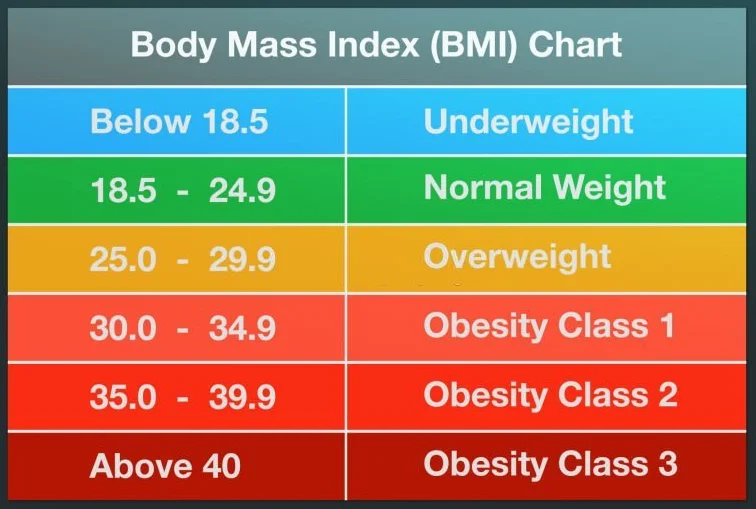
BMI Categories:
- Underweight: BMI less than 18.5
- Normal weight: BMI 18.5 to 24.9
- Overweight: BMI 25 to 29.9
- Obese: BMI 30 or greater
Limitations: BMI doesn't account for muscle mass, bone density, overall body composition, and racial and sex differences. For example, athletes might have a high BMI due to increased muscle mass rather than increased body fat.
Waist-to-Height Ratio is a simple screening tool that can indicate central obesity. For adults with a BMI below 35, waist-to-height ratio can be used alongside BMI as a practical estimate of central adiposity. NICE advises adults to aim to keep their waist circumference at less than half their height, corresponding to a waist-to-height ratio below 0.5.
- 0.40–0.49: Healthy central adiposity
- 0.50–0.59: Increased central adiposity
- 0.60 or above: High central adiposity
This calculator provides general information only. It is not a substitute for professional medical advice. Please consult a healthcare provider for personalized health guidance.
Complete-Healthy-Weight-Toolkit.Zip Only ($39.99 | $14.99)
How to use BMI Calculator Complete Guide?
What is a BMI Calculator?
A BMI Calculator is a simple tool that estimates whether your weight is healthy for your height. It uses the internationally recognized Body Mass Index (BMI) formula to calculate your BMI score in seconds. The result helps identify whether you are underweight, at a healthy weight, overweight, or living with obesity. While BMI is a useful screening tool, it does not directly measure body fat or overall health. Use our BMI Calculator for a quick and free assessment to better understand your weight status.
How to Calculate BMI?
The Body Mass Index is a quick and simple screening tool that relates your weight to your height. While it has limitations and doesn’t measure body fat directly, it’s often used by healthcare professionals to broadly categorize a person’s weight and potential health risks.
You can calculate BMI using either the Metric System or the Imperial System (US Units).
Metric BMI Formula
The metric formula is the standard way to calculate BMI:
Steps:
- Measure your weight in kilograms (kg).
- Measure your height in meters (m). If you know it in centimeters (cm), divide the centimeters by 100 to convert to meters (e.g. 175 cm / 100 = 1.75 m).
- Square your height in meters (multiply the height by itself).
- Divide your weight (kg) by your squared height (m2).
Example:
- Weight: 75 kg
- Height: 1.75 m
US Imperial BMI Formula
If you use pounds and inches, you’ll need a conversion factor (703) in the calculation:
Steps:
- Measure your weight in pounds (lb).
- Measure your height in inches (in). (Remember, 1 foot = 12 inches).
- Square your height in inches (multiply the height by itself).
- Divide your weight (lb) by your squared height (in2).
- Multiply that result by the conversion factor, 703.
Example:
- Weight: 150 lb
- Height: 5’5″ (which is 5 X 12 + 5 = 65 inches)
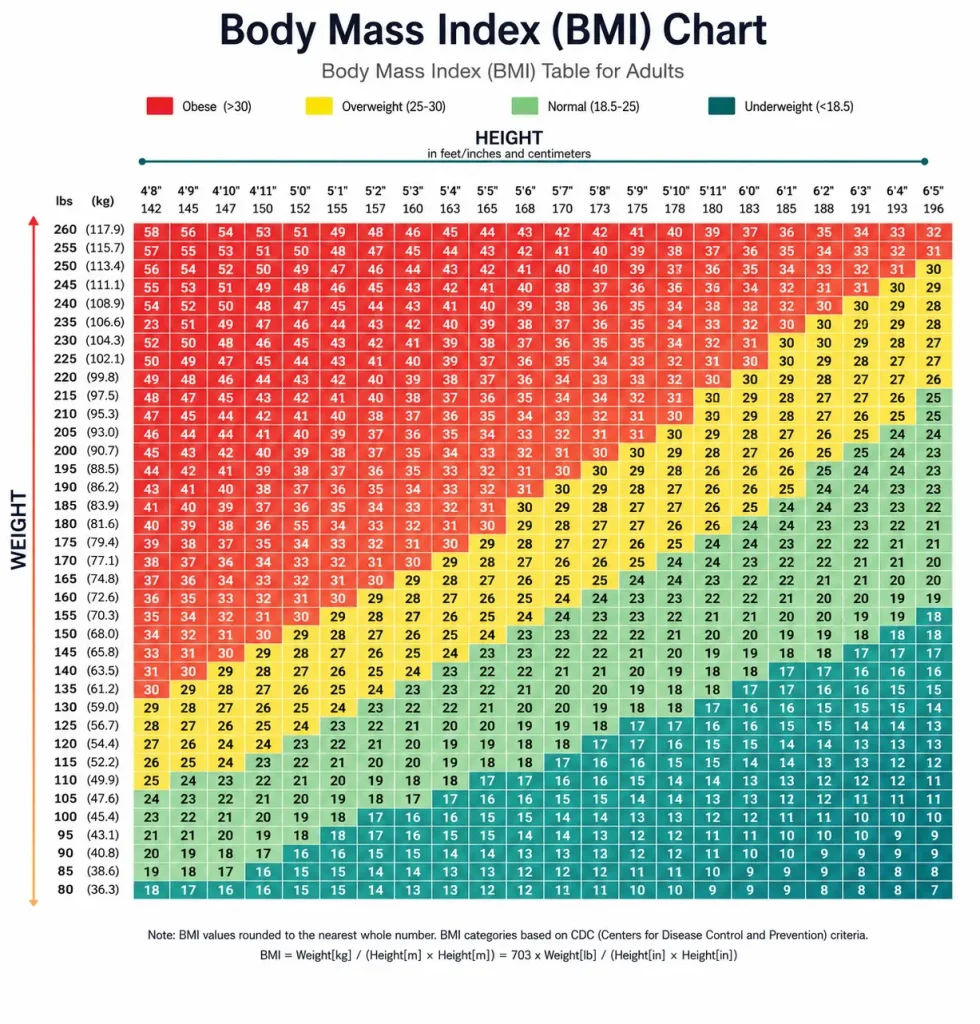
Body Mass Index (BMI) Table for Adults
Use this Body Mass Index (BMI) Table for Adults to quickly check BMI ranges based on your height and weight. This easy-to-read BMI chart shows underweight, normal weight, overweight, and obese categories for adults. Save this helpful BMI reference chart for quick access and share it with others interested in understanding their BMI range.
What Is BMI Used For?
BMI is commonly used as a simple screening measure of weight relative to height. For individuals, it can help identify weight categories that may warrant further assessment. At the population level, BMI is also useful for tracking weight-related trends.
BMI should not be used as a diagnosis on its own. Healthcare professionals may consider it alongside medical history, lifestyle, physical examination findings, blood pressure, laboratory results, and other measurements.
Frequently Asked Questions About BMI
1. What is BMI and what does a BMI calculator tell me?
Body Mass Index (BMI) is a screening measure that compares your weight with your height. A BMI calculator uses these two measurements to estimate your BMI and place the result into a general adult weight category, such as underweight, healthy weight, overweight, or obesity.
BMI can be a useful starting point for understanding weight status, but it does not directly measure body fat or diagnose a health condition. It is best considered alongside other factors such as waist measurement, lifestyle, medical history, and advice from a healthcare professional.
2. What is considered a healthy BMI for adults?
For most adults, the standard BMI categories are:
- Underweight: below 18.5
- Healthy weight: 18.5 to 24.9
- Overweight: 25.0 to 29.9
- Obesity: 30.0 or above
These ranges are commonly used as a screening tool to classify weight relative to height. However, being within a particular BMI category does not by itself determine whether someone is healthy or unhealthy. Other health measurements and individual circumstances should also be considered.
3. Is BMI accurate for everyone?
BMI is useful for population-level screening and as a quick estimate of weight status, but it has important limitations. It does not distinguish between muscle, fat, and bone mass or show where body fat is stored.
For example, someone with a high amount of muscle may have a higher BMI without having excess body fat. BMI should therefore be viewed as one health indicator rather than a complete assessment of your body composition or overall health.
4. Why does this BMI calculator also show waist-to-height ratio?
Waist-to-height ratio provides additional information about how much fat may be carried around the waist. This is useful because BMI alone does not show where body fat is distributed.
To calculate it, divide your waist circumference by your height using the same units. As a simple general guideline, adults are often advised to try to keep their waist circumference to less than half of their height, which corresponds to a waist-to-height ratio below 0.5.
Using waist-to-height ratio alongside BMI can provide a more complete picture than BMI alone, particularly when assessing central body fat.
5. Can children or teenagers use this BMI calculator?
This calculator is designed for adults and should not be used to interpret the weight status of children or teenagers.
For people aged 2 to 19, BMI is interpreted differently because children are still growing. Their results are usually assessed using BMI-for-age percentiles, which take age and sex into account.
Parents or caregivers who are concerned about a child’s growth or weight should use an appropriate child and teen BMI tool and discuss the results with a qualified healthcare professional.
6. Can I use BMI during pregnancy?
A standard adult BMI calculator is not suitable for assessing weight status during pregnancy because normal pregnancy-related weight gain changes body weight over time.
Healthcare professionals may use a person’s pre-pregnancy BMI when discussing appropriate pregnancy weight-gain goals, but BMI calculated using current pregnancy weight should not be interpreted in the same way as a standard adult BMI result.
If you are pregnant and have questions about your weight or appropriate weight gain, speak with your doctor, midwife, or another qualified healthcare professional.
7. What should I do if my BMI is outside the healthy-weight range?
A BMI outside the healthy-weight range does not automatically mean that you have a health problem. BMI is a screening measure and should be interpreted alongside other information such as waist circumference, medical history, physical activity, eating habits, blood pressure, laboratory results, and other health factors.
Consider your result as a starting point for understanding your health rather than a diagnosis. If your BMI is below or above the healthy-weight range, or if you have concerns about your weight, discuss the result with a qualified healthcare professional who can provide advice based on your individual circumstances.
Sources & References
We aim to support important health information with reputable public-health and medical sources.
- Centers for Disease Control and Prevention (CDC) — Body Mass Index information and adult BMI categories.
View CDC BMI information - Centers for Disease Control and Prevention (CDC) — Adult BMI categories and interpretation.
View adult BMI categories - National Institute for Health and Care Excellence (NICE) — Guidance relating to BMI and waist-to-height ratio.
View NICE guidance - World Health Organization (WHO) — Information relating to overweight and obesity.
View WHO information
Sources are provided for general reference. Health guidance may change over time, and individual medical advice should come from a qualified healthcare professional.